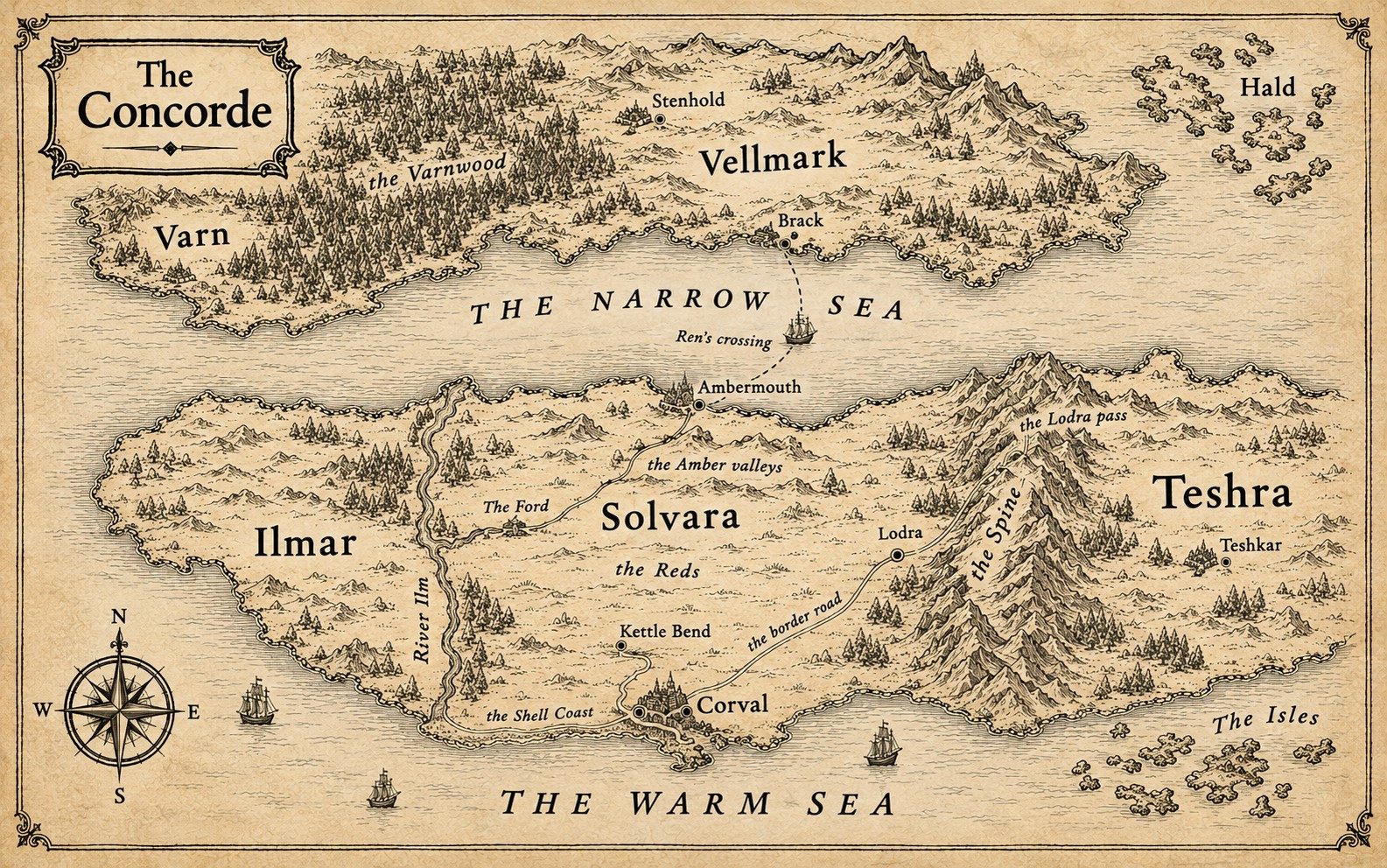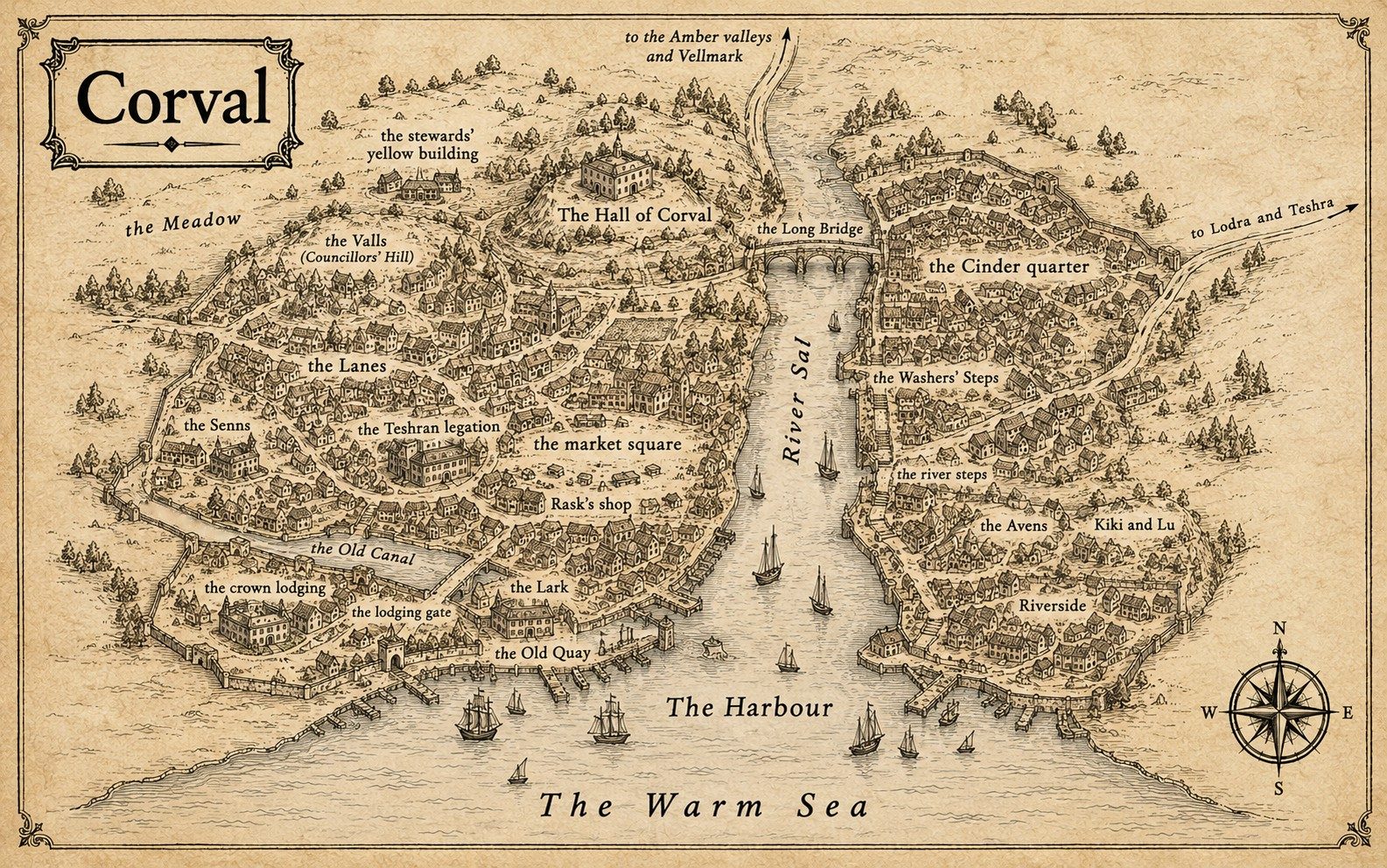
A Novel of the Concorde
The book
Ren Wyke, a customs clerk's son from the cold north, wins a place almost by accident. Asked at his interview what he fears most, he tells the truth: singing. So they make him sing. The Hall of Stenhold keeps every word ever sung inside it, and it plays his cracked voice back to a laughing room. It will keep that too.
Corval, in the warm south, is nothing like home. Dinner is when the shutters open, and you refuse food twice before you're allowed to eat. The widow who takes Ren in sets a place every night for a son who is far away. And Ren makes friends he never planned on: Mireth, who sings badly on purpose and is loved for it, and her oldest friend Lisvet, who can take a person apart in two sentences.
A guest who says the wrong thing goes home on the next ship, and Ren has always been good at keeping quiet. In Corval he will learn what that costs.
Telling One
The Journal
The year in the south, from the journal Ren kept at eighteen.
Telling Two
Lisvet
The same year, told by the one who saw what he didn't.
Telling Three
The Man
Ren, thirty years later, still working out what he owes.
How to be a guest in Corval
- At the tableRefuse twice. Eat on the third offer.
- In the streetTime is told by the shutters, and nobody agrees when that is.
- In the HallEverything sung in the stones is kept, and cannot be unsung.
- At home, in VellmarkArrive a quarter of an hour early. Everyone does.
Read the opening
Chapter 1 · The Hall
In Vellmark you arrive a quarter of an hour early. Everyone does, which means a quarter of an hour early is when everyone arrives, which means it is on time, and anyone who comes at the hour written on the letter is late. I worked this out when I was nine. On the morning of my interview I arrived at the Hall of Stenhold half an hour early, to be safe, and found eleven people already on the bench outside the doors, all of whom had had the same idea, and all of whom were better dressed than me.
Eleven. With me it made twelve, which I took as a good sign, because I was eighteen and took everything as a sign. I did not know yet that there had been twelve on that bench every morning for a month: near three hundred of us, from every town in Vellmark, for thirty places. I counted their coats while we waited. Four were new. Three had been let out at the seams. Two had been bought for this. The last two, like mine, had been somebody's father's, and you could tell because the sleeves were cut for a man who stood differently.
The boy next to me had a silver pin in his lapel shaped like a ship. His father owned ships, he told me, without my asking, and his family had sent someone on the Exchange every generation since the Concorde. He asked what my father did.
"He's a clerk," I said. "At the customs house in Brack."
"Oh," he said, in the voice people use for a dog that has done something on the floor, kindly, because it's not the dog's fault.
Continue reading on Kindle or in paperback.
The maps